values  <- c(8, 5, 3, 6, 4, 7)   # value of each project
costs   <- c(5, 3, 2, 4, 3, 5)   # its cost
budget  <- 11
projects <- paste0("P", seq_along(values))11 Mixed-Integer Programming
NoteWhat you’ll be able to do
Add integer or boolean decision variables to a model and solve the resulting mixed-integer linear program with HiGHS — no extra install. Solve a mixed-integer quadratic problem with SCIP, and see the second-order cone CVXR uses to get it there.
11.1 Discrete decisions
So far every variable was continuous. But many real decisions are discrete: select this project or not, how many units to ship, which facility to open. Encoding those as integer or boolean variables turns a convex problem into a mixed-integer one. These are no longer convex — they are combinatorial and NP-hard in general — but CVXR hands them to a solver that does branch-and-bound over a sequence of convex relaxations. You write the model the same way; you just declare some variables integer = TRUE or boolean = TRUE.
11.2 Hands-on: a 0/1 knapsack (MILP)
The classic discrete problem: choose a subset of items to maximize total value without exceeding a budget. With a linear objective and boolean variables this is a mixed-integer linear program (MILP) — squarely within HiGHS, one of CVXR’s built-in CRAN solvers.
pick <- Variable(length(values), boolean = TRUE)     # 1 = select, 0 = skip
prob <- Problem(Maximize(sum(values * pick)),
                list(sum(costs * pick) <= budget))
psolve(prob, solver = "HIGHS")
[1] 17selected <- projects[value(pick) > 0.5]
cat("Selected:", paste(selected, collapse = ", "),
"\nTotal value:", sum(values[value(pick) > 0.5]),
" Total cost:", sum(costs[value(pick) > 0.5]), "/", budget, "\n")Selected: P1, P2, P5
Total value: 17 Total cost: 11 / 11 The boolean = TRUE is the whole story — it forces each pick to 0 or 1. Drop it and you would get the (fractional) LP relaxation, an upper bound that is often not achievable with whole items:
pick_lp <- Variable(length(values))
relax <- Problem(Maximize(sum(values * pick_lp)),
                 list(sum(costs * pick_lp) <= budget, pick_lp >= 0, pick_lp <= 1))
cat("LP relaxation value:", round(psolve(relax, solver = "HIGHS"), 3),
    "(>= the integer optimum)\n")
LP relaxation value: 17.5 (>= the integer optimum)round(value(pick_lp), 3) [,1]
[1,] 1.00
[2,] 1.00
[3,] 0.00
[4,] 0.75
[5,] 0.00
[6,] 0.00That gap between the relaxation and the integer optimum is exactly what branch-and-bound has to close.
11.3 Integer least squares (SCIP)
Here is a mixed-integer problem straight out of our regression chapters: integer least squares — find integer coefficients \(x\) minimizing \(\|Ax - b\|_2^2\). A quadratic objective with integer variables is a mixed-integer quadratic program (MIQP), and the obvious transcription just works:
set.seed(0)
A <- matrix(runif(12 * 5), 12, 5); b <- rnorm(12)
x <- Variable(5, integer = TRUE)
psolve(Problem(Minimize(sum_squares(A %*% x - b))), solver = "SCIP")
[1] 6.710382xhat <- value(x)
cat("integer x:", round(xhat), "\n")integer x: -1 0 1 1 0 SCIP has no quadratic objective of its own, so how did that work? CVXR used the skill from Chapter 3: it reformulated the problem. Minimizing \(\|Ax-b\|_2^2\) is the same as minimizing \(t\) subject to \(\|Ax-b\|_2^2 \le t\), and that constraint is a second-order cone — which makes the problem an MI-SOCP, exactly what SCIP handles. You can write the cone yourself and get the same integer optimum:
t <- Variable()
prob <- Problem(Minimize(t), list(p_norm(A %*% x - b, 2) <= t))  # SOC epigraph
psolve(prob, solver = "SCIP")
[1] 2.59044cat("integer x:", round(value(x)), " sum of squares:",
round(sum((A %*% value(x) - b)^2), 4), "\n")integer x: -1 0 1 1 0 sum of squares: 6.7104 Here \(t\) is the norm, not its square, so the optimal value is the square root of the first one; the minimizer is the same. SOC plus integers is SCIP’s home turf. (With CVXR 1.9.2 and earlier, the squared form was routed to commercial solvers only, and writing the cone by hand, as above, was how to solve it on CRAN.)
NoteA current limitation (it may change)
This reflects the state of the tooling today, not a permanent rule — worth knowing now, but re-test rather than assume, since solvers keep evolving.
- HiGHS with an SOC inside a mixed-integer problem. As of this writing, HiGHS does not support a second-order cone in a mixed-integer model, and rather than erroring it can silently return a wrong
infeasible— so for now, send SOC + integers to SCIP. HiGHS is under active development, so check before relying on it.
11.4 Exercise
Exercise. Add a rule to the knapsack: projects P1 and P2 are mutually exclusive (at most one may be chosen). Re-solve and see what changes.
TipSolution
A “select at most one” rule is the linear constraint pick[1] + pick[2] <= 1:
prob2 <- Problem(Maximize(sum(values * pick)),
                 list(sum(costs * pick) <= budget,
                      pick[1] + pick[2] <= 1))
psolve(prob2, solver = "HIGHS")
[1] 17projects[value(pick) > 0.5][1] "P1" "P3" "P4"Logical rules like mutual exclusion, prerequisites (pick[a] <= pick[b]), or “pick exactly k” are all just linear constraints on 0/1 variables.
11.5 Bonus: solving Sudoku
Sudoku is a pure feasibility integer program — there is nothing to optimize, only constraints to satisfy. It is a lovely illustration of how “exactly one of these” rules become linear equations on boolean variables.
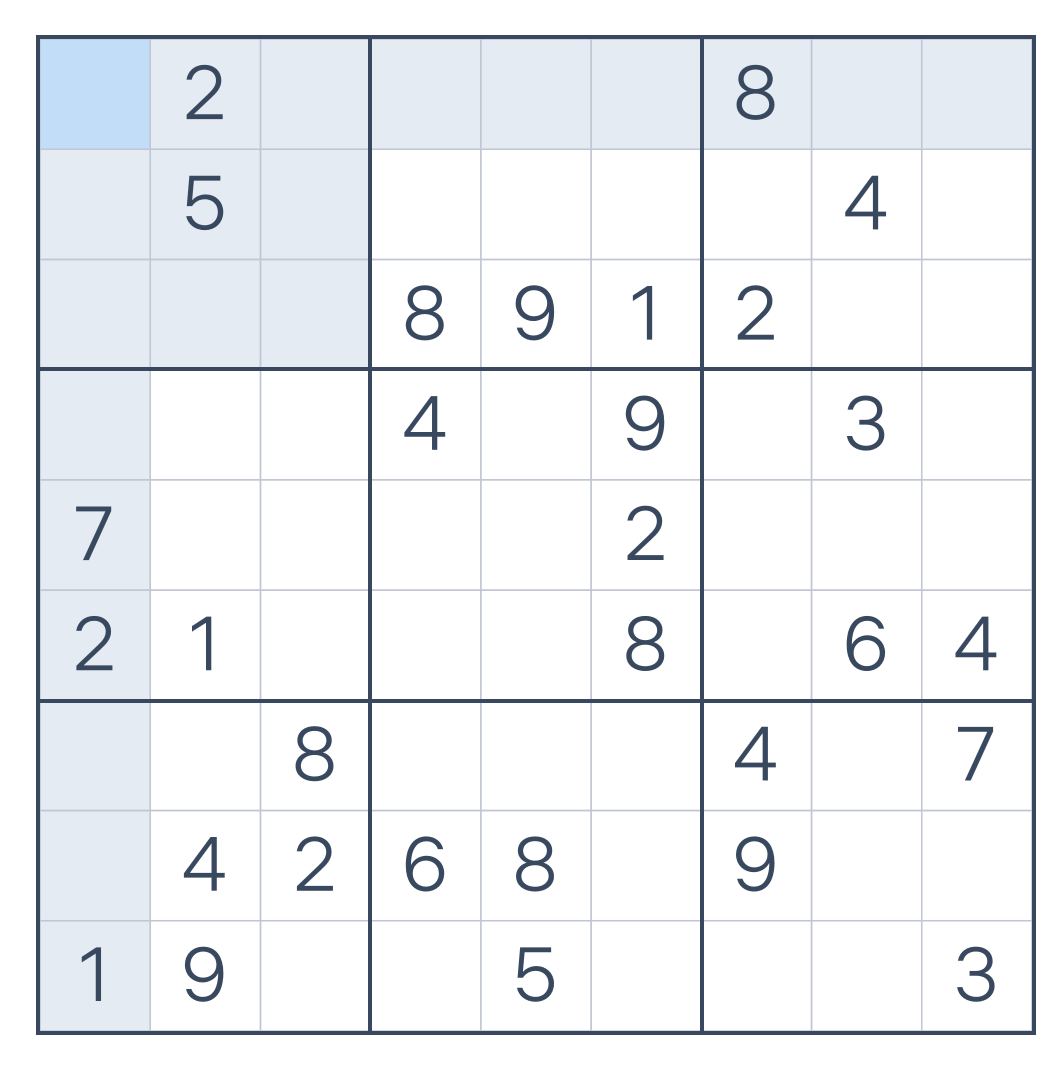
0.We store the grid as a \(9\times 9\) matrix, using 0 for a blank cell:
puzzle <- matrix(c(
  0,2,0, 0,0,0, 8,0,0,
  0,5,0, 0,0,0, 0,4,0,
  0,0,0, 8,9,1, 2,0,0,
  0,0,0, 4,0,9, 0,3,0,
  7,0,0, 0,0,2, 0,0,0,
  2,1,0, 0,0,8, 0,6,4,
  0,0,8, 0,0,0, 4,0,7,
  0,4,2, 6,8,0, 9,0,0,
  1,9,0, 0,5,0, 0,0,3), nrow = 9, byrow = TRUE)
11.5.1 The formulation
The trick is to replace each cell’s digit with nine yes/no decisions. Define a boolean variable for every (cell, digit) pair:
\[ x_{ijk} = \begin{cases} 1 & \text{if cell } (i,j) \text{ holds digit } k,\\ 0 & \text{otherwise,}\end{cases} \qquad i,j,k \in \{1,\dots,9\}. \]
That is \(9\times 9\times 9 = 729\) booleans. Every Sudoku rule is now an “exactly one” count — a sum of these booleans set equal to 1:
\[ \begin{array}{lll} \textstyle\sum_{k} x_{ijk} = 1 & \forall\, i,j & \text{(each cell holds exactly one digit)}\\[2pt] \textstyle\sum_{j} x_{ijk} = 1 & \forall\, i,k & \text{(digit } k \text{ appears once in each row } i)\\[2pt] \textstyle\sum_{i} x_{ijk} = 1 & \forall\, j,k & \text{(digit } k \text{ appears once in each column } j)\\[2pt] \textstyle\sum_{(i,j)\in B} x_{ijk} = 1 & \forall\, \text{box } B,\ k & \text{(digit } k \text{ appears once in each } 3\times3 \text{ box)}\\[2pt] x_{ij g_{ij}} = 1 & \text{for each clue } g_{ij} & \text{(given numbers are fixed)} \end{array} \]
There is no objective — any grid satisfying all of these is the answer, so we minimize the constant 0 and let the solver find a feasible point.
11.5.2 In CVXR
We hold the booleans as a list of nine \(9\times 9\) matrices, X[[k]] being the indicator that each cell equals digit k. Each block of constraints below mirrors one line of the formulation. (Recall CVXR’s 1-based axes from earlier: axis = 1 sums each row, axis = 2 sums each column.)
X <- lapply(1:9, function(k) Variable(c(9, 9), boolean = TRUE))

cons <- list(Reduce(`+`, X) == matrix(1, 9, 9))          # one digit per cell

for (k in 1:9) {
  cons <- c(cons,
            list(sum_entries(X[[k]], axis = 1) == 1,      # digit k once per row
                 sum_entries(X[[k]], axis = 2) == 1))     # digit k once per column
  for (br in 0:2) for (bc in 0:2) {                       # digit k once per 3x3 box
    rows <- (3 * br + 1):(3 * br + 3)
    cols <- (3 * bc + 1):(3 * bc + 3)
    cons <- c(cons, list(sum_entries(X[[k]][rows, cols]) == 1))
  }
}

for (i in 1:9) for (j in 1:9) if (puzzle[i, j] != 0)     # fix the clues
  cons <- c(cons, list(X[[puzzle[i, j]]][i, j] == 1))
Solve it as a feasibility problem and read the chosen digit in each cell:
psolve(Problem(Minimize(0), cons), solver = "HIGHS")[1] 0solution <- matrix(0, 9, 9)
for (k in 1:9) solution[round(value(X[[k]])) == 1] <- k
solution [,1] [,2] [,3] [,4] [,5] [,6] [,7] [,8] [,9]
[1,] 9 2 6 3 4 5 8 7 1
[2,] 8 5 1 7 2 6 3 4 9
[3,] 4 7 3 8 9 1 2 5 6
[4,] 6 8 5 4 7 9 1 3 2
[5,] 7 3 4 1 6 2 5 9 8
[6,] 2 1 9 5 3 8 7 6 4
[7,] 5 6 8 9 1 3 4 2 7
[8,] 3 4 2 6 8 7 9 1 5
[9,] 1 9 7 2 5 4 6 8 3A few hundred boolean variables, a couple hundred linear constraints, and HiGHS fills the grid in well under a second — with no Sudoku-specific algorithm, just the rules written as constraints. (Swap in any puzzle by editing the 0-padded matrix.)
11.6 Takeaways
- Declaring a variable
integer = TRUEorboolean = TRUEturns a model into a mixed-integer program — same modeling, combinatorial solving. - MILP (linear objective) runs on HiGHS, built in and install-free.
- MI-SOCP (a cone plus integers) runs on SCIP. So does an integer problem with a quadratic objective (MIQP): CVXR rewrites the quadratic as a second-order cone for you.
- Match the solver to the problem — today a pure-MILP solver like HiGHS can’t handle an SOC (and may not tell you), so send those to SCIP for now.
- Some integer problems have no objective at all: logical puzzles like Sudoku are pure feasibility programs, where every rule is an “exactly one” sum of booleans.
See Mixed-Integer QP and Integer Programming.